News

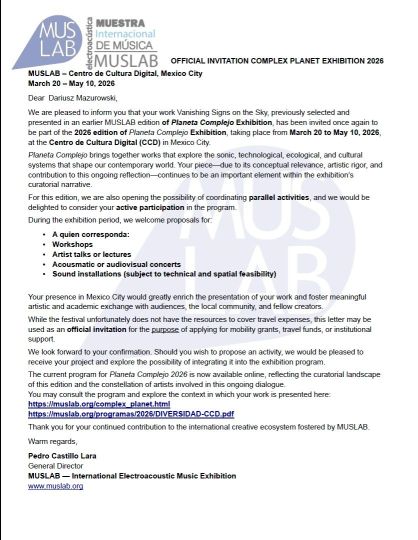
This Friday, March 20th, the next edition of the MUSLAB – Planeta Complejo festival begins at the Centro de Cultura Digital (CCD) in Mexico City. It will run until May 10th and bring many interesting events, all related to electroacoustic music. Many works from around the world will also be presented, and I'm especially pleased to be invited to participate in this event again. If memory serves, my music first appeared at the Muslab festival in 2015, so it's been over 10 years of regularly presenting my compositions.


While recently publishing my extensive text on the use of AI in music, I realized I had quite a bit of other material I'd been preparing for various scientific conferences, lectures, and other occasions. And these texts could, of course, be publicly available to anyone potentially interested. So I decided to gradually publish them in the open scientific repository https://zenodo.org/, created over a decade ago by CERN. It's an incredibly rich, interdisciplinary collection—certainly worth recommending. Currently, there are five of my texts there (including one co-written with Tomasz Misiak), all of which can be found here: https://zenodo.org/search?q=metadata.creators.person_or_org.name%3A%22Mazurowski%2C%20Dariusz%22&l=list&p=1&s=10&sort=bestmatch - each in English and Polish, as a PDF file (which you can read directly on the website or download). Specifically, these are the following titles:

1. Artificial Intelligence in Music Composition and Production

2. Interaction between a live instrument and the electronic part on the example of accordion music the sound perception from the points of view of the composer and performers

3. Acoustic Space and Sound Environment: The Philosophy and Aesthetics of Soundscapes on the Example of Metropolis Balticum (Urbana Landscape)

4. Space, Diffusion, Perception Selected Issues Concerning the Spatiality of Sound in Electroacoustic Music

5. The Accordion as a Metaphorical Acoustic Synthesizer in Electroacoustic Music. An Outline of Extended Performance Techniques Based on the Composer's Own Works


All available free of charge under the Creative Commons Attribution 4.0 International (CC BY 4.0) license.

Yesterday, I formally concluded the project entitled From Studio to Network – Developing Creative Competencies in the Age of Technology, which was implemented as part of the KPO program for culture. This marked the end of a six-month period of extremely intensive work in several areas of my compositional activity – even though at the same time I was also pursuing other activities, playing concerts in Poland and abroad, composing, producing my own recordings and those of other artists, and writing articles. Professionally, this was one of the most intense periods in my already quite long musical life. I also learned that even an experienced composer, musician, and producer can always learn something new, master technological advancements, and expand their work and knowledge into new areas. These six months have transformed me into a "version after a major technological and competency update." A significant benefit has been not only the new tools I've implemented, but also new professional contacts – people with whom I've had the opportunity to meet, talk, and exchange experiences. More specifically and briefly:

- I undertook a study visit abroad to the Composition Department of the HAMU in Prague, combined with an intensive MaxMSP course led by John MacCallum.

- I also completed three more study visits, this time domestically: to the Electroacoustic Music Studio of the Academy of Music in Kraków (during which I also recorded a significant amount of audio material for new works), the New Media Department of the Academy of Music in Wrocław, and the Chopin University Electronic Music Studio in Warsaw.

- I completed two extensive online courses: one on AI applications in music and one on digital music distribution on the internet.

- I had in-person and online consultations with four expert musicians specializing in the performance of new music on wind instruments, specifically oboe, saxophones, and flutes. As part of these consultations, I also recorded audio material that was used to process and build the electronic layer of the new compositions.

- I conducted my own educational and research activities, developing digital competencies in the field of immersive sound and virtual acoustic environments, as well as the application of AI in musical activities in the broadest sense.

- I implemented a platform for remote work with other musicians, selected through numerous trials, based on internet connections and audio transmission, continuing my collaboration with my distinguished composer colleague from Chicago, Brad Robin.

- I also purchased advanced software and hardware necessary to fully implement the project and its subsequent plans.

- As a result of my research, I wrote an article on the musical applications of artificial intelligence in the process of composing and producing a musical piece – I mentioned it a few days ago, and the text is available in Polish and English here: https://zenodo.org/records/18787416

- And finally, I composed two new pieces incorporating the experiences gained during this project.

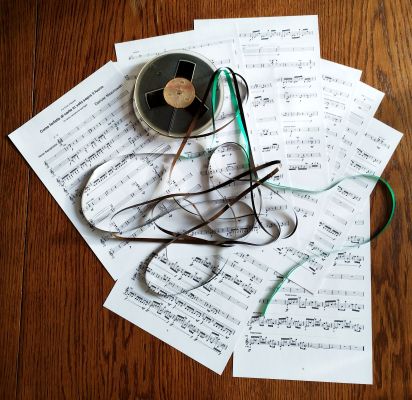
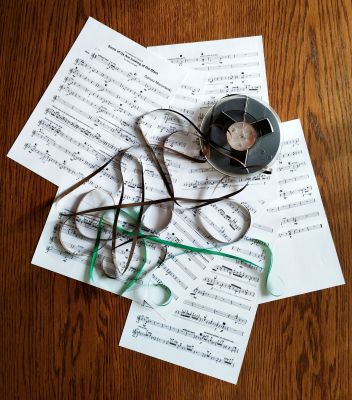
I'd like to devote a few words to these compositions. Both were written specifically for outstanding musicians whom I deeply respect and with whom it's a pure pleasure to collaborate: Some of Us Are Looking at the Stars for oboe and electronic part for Aleksandra Panasik, and Come farfalle di carta in volo sopra il fuoco for tenor saxophone and electronic part for Enzo Filippetti.

With half a year of intensive work behind me, I thank everyone who accompanied me, helped me, and supported me throughout – with new knowledge and ideas, I move forward. Plans are already afoot for further projects, live performances, recordings, and many other endeavors.

The project was co-financed by the European Union's NextGenerationEU fund as part of the National Recovery Plan.


As part of a project titled "From Studio to Network – Developing Creative Competencies in the Age of Technology," which was implemented as part of the KPO for Culture program, I did research on various aspects of using artificial intelligence in the broadly defined work of a composer. This resulted in a comprehensive article, which I'm sharing here – it is available to anyone interested in this topic. The text is available in PDF format on the Zenodo website: https://zenodo.org/records/18787416 – it can be read online or downloaded. Important note: it is available in two languages: Polish and English.

The project was co-financed by the European Union's NextGenerationEU fund as part of the National Recovery Plan.


https://zenodo.org/records/18787416

On February 13th, ALTOTRONICA, a CD album by the outstanding violist Krzysztof Komendarek-Tymendorf, was officially released by the American label Centaur Records. I had the pleasure of working with Krzysztof on this album. I composed the opening track Waveless Storm for him, mastered the entire album, and helped with the final production of several other tracks. Due to my involvement, I'm probably not entirely objective, feeling emotionally attached to this material, but I wholeheartedly recommend it – it's an exceptional album, a collection of very different pieces, yet always combining two elements – the noble sound of the viola with electronics. It also offers a survey of the work of a wide range of Polish composers, which in itself is a great asset to the album. Friday, February 13th will certainly be a lucky date for ALTOTRONICA, and I'm keeping my fingers crossed for its success.


On Saturday, January 24, another installment of the play Strange Things took place, a comedy horror film set in the 1980s.


On Wednesday, January 21st, an important event will take place in Paris – as part of the anniversary edition of the 50th International Viola Congress in Paris, the outstanding violist Krzysztof Komendarek-Tymendorf will perform a recital. His program will include, among others, my composition "Waveless Storm" (which I wrote especially for Krzysztof and which is included on the recently released ALTOTRONICA album), as well as our joint piece from the "Extrēmus" program, specifically "Extreme Dissonant Alchemy." Krzysztof will also give a lecture, "Polish heritage for viola solo and electronics." Needless to say, both of these pieces are for viola with electronics, and in the latter case, also live. The event will take place at the Conservatoire Nadia et Lili Boulanger. More about the event and the congress itself: https://www.the50thinternationalviolacongress.com/en


I spent December 17th and 18th in Warsaw on a study visit to the Chopin University Electronic Music Studio, located at the Department of Composition at the Fryderyk Chopin University of Music. I familiarized myself with the modern technology available to the university and its studios, particularly the tools for working with surround sound (Dolby Atmos, etc.). This visit is possible thanks to the support received by my project "From Studio to Network – Development of Creative Competencies in the Age of Technology" under the KPO for Culture program. I would like to thank Wojciech Błażejczyk for the invitation. The project was co-financed by the European Union's NextGenerationEU fund as part of the National Recovery Plan.

#KorzyściDlaCiebie #NextGenerationEU #FunduszeUE #KPOdlaKultury #electroacousticmusic #sounddesign #AIinMusic #musicinnovation #creativeAI #newmusic